Elliptic Curve Cryptography
The Mathematics Behind Elliptic Curve Cryptography
In my latest posts, I have been explaining the mathematics behind various digital technologies including security. Previously, I explained how Elliptic Curve Cryptography (ECC) is used to create a Public Key out of a Private Key.
ECC: The Game of Geometry
Forget basic division and multiplication; on elliptic curves, math is a game of geometry.
What is an Elliptic Curve?
Before diving into how the math works, let's understand the foundation.
An elliptic curve is defined by a simple cubic equation known as the Weierstrass equation:
where and are constants chosen so that the curve is smooth (no cusps or self-intersections).
This equation creates a beautiful, symmetric, closed curve that looks somewhat like a tilted "S" or a loop lying on its side. All cryptographic operations in ECC happen using points that lie exactly on this curve.
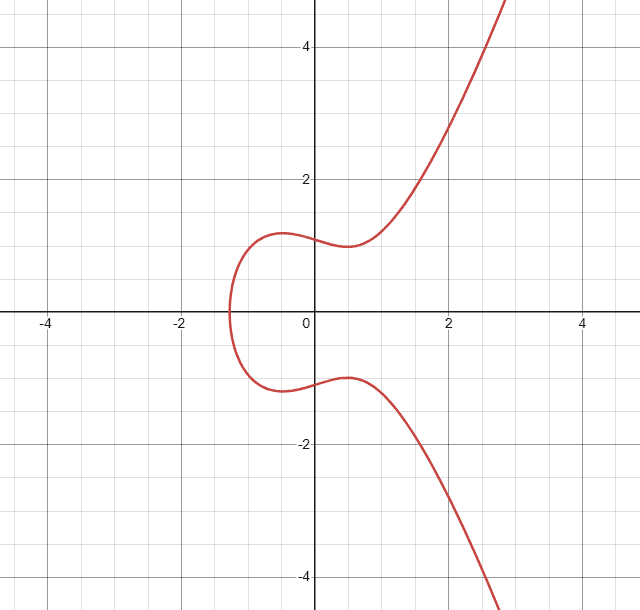
The Secret Geometry of ECC
We usually think of mathematics as moving along a straight number line. In Elliptic Curve Cryptography, however, everything happens on this closed curve.
The real power comes from the fact that ECC creates a one-way function: it is easy to go forward (compute the Public Key from the Private Key), but extremely hard to go backward (recover the Private Key from the Public Key).
Point Addition
Let me explain the Point Addition algorithm — the core operation that makes ECC work.
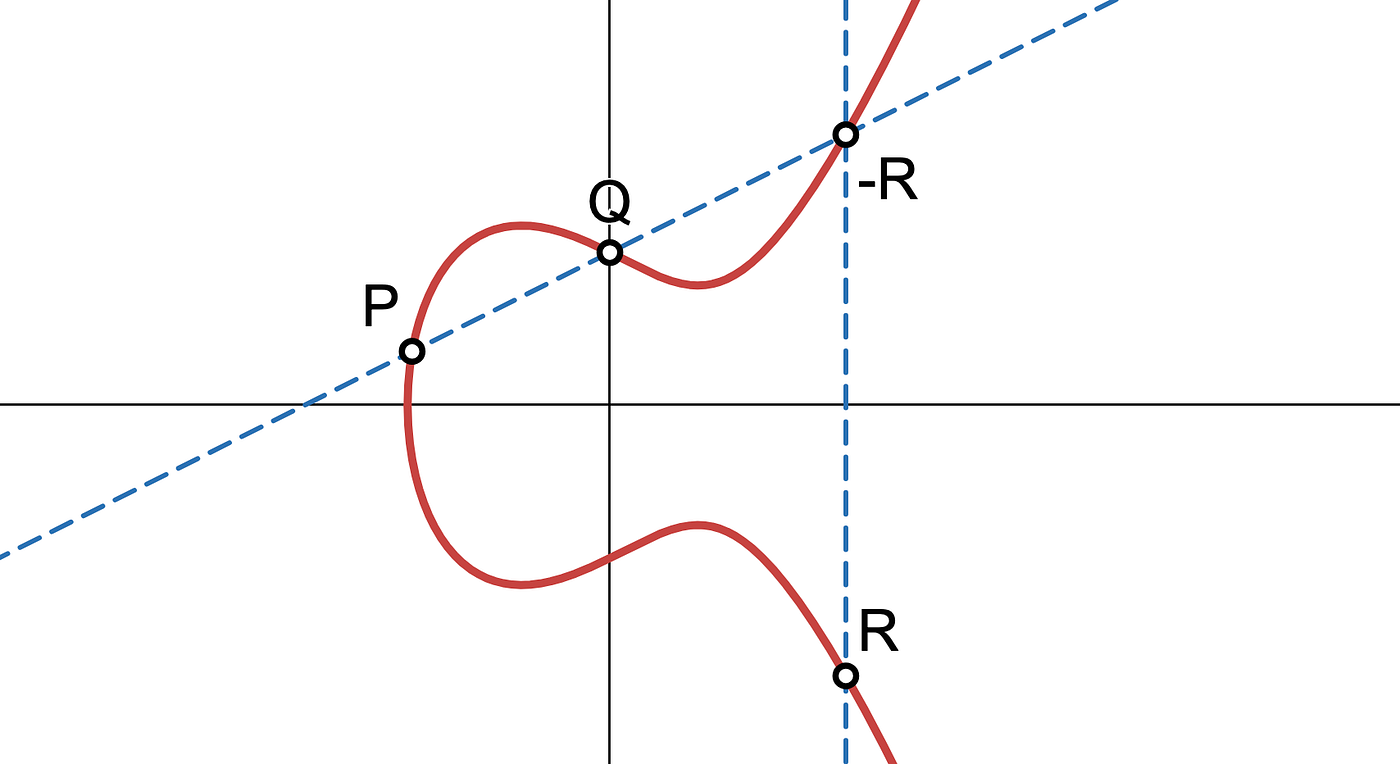
Adding Two Points ()
Here is how you add any two distinct points on the curve without a calculator:
Step A: Draw a straight line between and .
Step B: Where that line intersects the curve again is another point (we call it the "helper point").
Step C: Reflect ("flip") that helper point across the x-axis.
You will land exactly on the result point . No matter where and are placed (as long as the line is straight), you always get the same .
This geometric approach (using lines instead of traditional algebra) is what gives ECC its strong security against hackers.
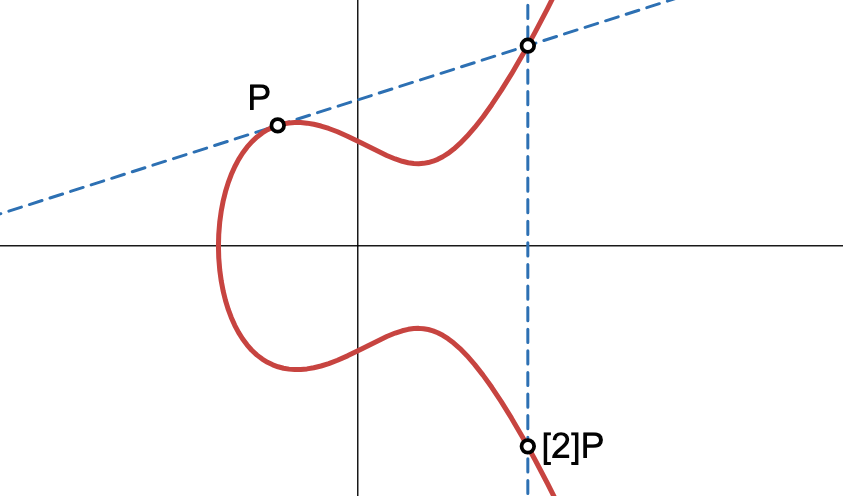
Adding a Point to Itself ()
What if you want to add a point to itself? You can't draw a straight line through the same point twice. Instead, you draw a tangent line at point (a line that just touches the curve at ).
This tangent line will intersect the curve at another point. Then, just like before, you reflect that intersection point across the x-axis to get the final result .
Where does the safety come from?
To generate the Public Key, your device repeatedly performs point addition millions or billions of times — for example:
The final point becomes your Public Key.
The huge number of operations () becomes your Private Key.
Looking at the final Public Key point, it is computationally infeasible to figure out how many "bounces" (additions) happened to reach there. The path is so unpredictable — like a bouncing ball on the curve — that reversing the process is practically impossible.
This is the beautiful "trapdoor" of elliptic curves.
Takeaway Points
- The Line rule: Any straight line drawn through two points on the curve will always intersect at a third point.
- The Reflection rule: We always reflect the third intersection point across the x-axis to get the final result.
- Mathematical trapdoor: Jumping forward (computing the Public Key) is easy, but jumping backward (to find the Private Key) is extremely hard.
Real-World Example: secp256k1 Curve
The exact same mathematics is used in real life with the secp256k1 elliptic curve — the curve used by Bitcoin, Ethereum, and many other cryptocurrencies.
You can see it in action with this simple Python code:
from ecdsa import SigningKey, SECP256k1

# Generate private key on secp256k1 curve
private_key = SigningKey.generate(curve=SECP256k1)

# Derive public key from private key
public_key = private_key.get_verifying_key()

print("Private Key: ", private_key.to_string().hex())
print("Public Key:  ", public_key.to_string().hex())
Final Thoughts
Elliptic Curve Cryptography transforms simple geometry into one of the strongest pillars of modern digital security. Starting from the basic equation , through point addition and doubling, we get a powerful one-way function that secures cryptocurrencies and protects our online communications every day.